ArsTechnica


In new level of stupid, RFK Jr.’s anti-vaccine advisors axe MMRV recommendation
The panel of vaccine advisors hand-selected by anti-vaccine activist Robert F. Kennedy Jr. voted on Thursday to change the federal vaccine recommendations for children, removing safe, well-established vaccine doses from current schedules and realizing Kennedy's anti-vaccine agenda to erode federal vaccine policy and sow distrust.
Specifically, the panel—the Advisory Committee on Immunization Practices (ACIP)—voted to remove the Centers for Disease Control and Prevention's previous recommendation for use of a measles, mumps, rubella, varicella (chickenpox) MMRV combination vaccine for children under 4 years old.
The contextIn June, Kennedy fired all 17 highly qualified, highly vetted members of ACIP and quickly replaced them with seven questionable members, who largely did not have subject matter expertise. Moreover, many of them have clearly expressed anti-vaccine rhetoric and skepticism about pandemic responses and COVID-19 vaccines. At least two new members have been paid witnesses in trials against vaccine makers, a clear conflict of interest. Earlier this week, Kennedy added five additional members, who raise the same anti-vaccine concerns as the first group.
Meet the 2025 Ig Nobel Prize winners
Does alcohol enhance one's foreign language fluency? Do West African lizards have a preferred pizza topping? And can painting cows with zebra stripes help repel biting flies? These and other unusual research questions were honored tonight in a virtual ceremony to announce the 2025 recipients of the annual Ig Nobel Prizes. Yes, it's that time of year again, when the serious and the silly converge—for science.
Established in 1991, the Ig Nobels are a good-natured parody of the Nobel Prizes; they honor "achievements that first make people laugh and then make them think." The unapologetically campy awards ceremony features miniature operas, scientific demos, and the 24/7 lectures whereby experts must explain their work twice: once in 24 seconds and the second in just seven words.
Acceptance speeches are limited to 60 seconds. And as the motto implies, the research being honored might seem ridiculous at first glance, but that doesn't mean it's devoid of scientific merit. In the weeks following the ceremony, the winners will also give free public talks, which will be posted on the Improbable Research website.
“Get off the iPad!” warns air traffic control as Spirit flight nears Air Force One
As Air Force One journeyed from the US to the UK this week, it came within eight lateral miles of a Spirit Airlines flight heading up the East Coast from Fort Lauderdale to Boston. An alert air traffic controller in the New York control center reached out to the Spirit flight, telling it to execute an immediate right turn to avoid any possibility of colliding with Air Force One.
But the Spirit pilots did not respond immediately, leading the testy air traffic controller to scold them repeatedly. (You can listen to the audio archive on LiveATC.net; it begins at around the 23:15 mark.)
"Pay attention!" said the controller after his first instruction was not acknowledged. "Spirit 1300, turn 20 degrees right."
Google announces massive expansion of AI features in Chrome
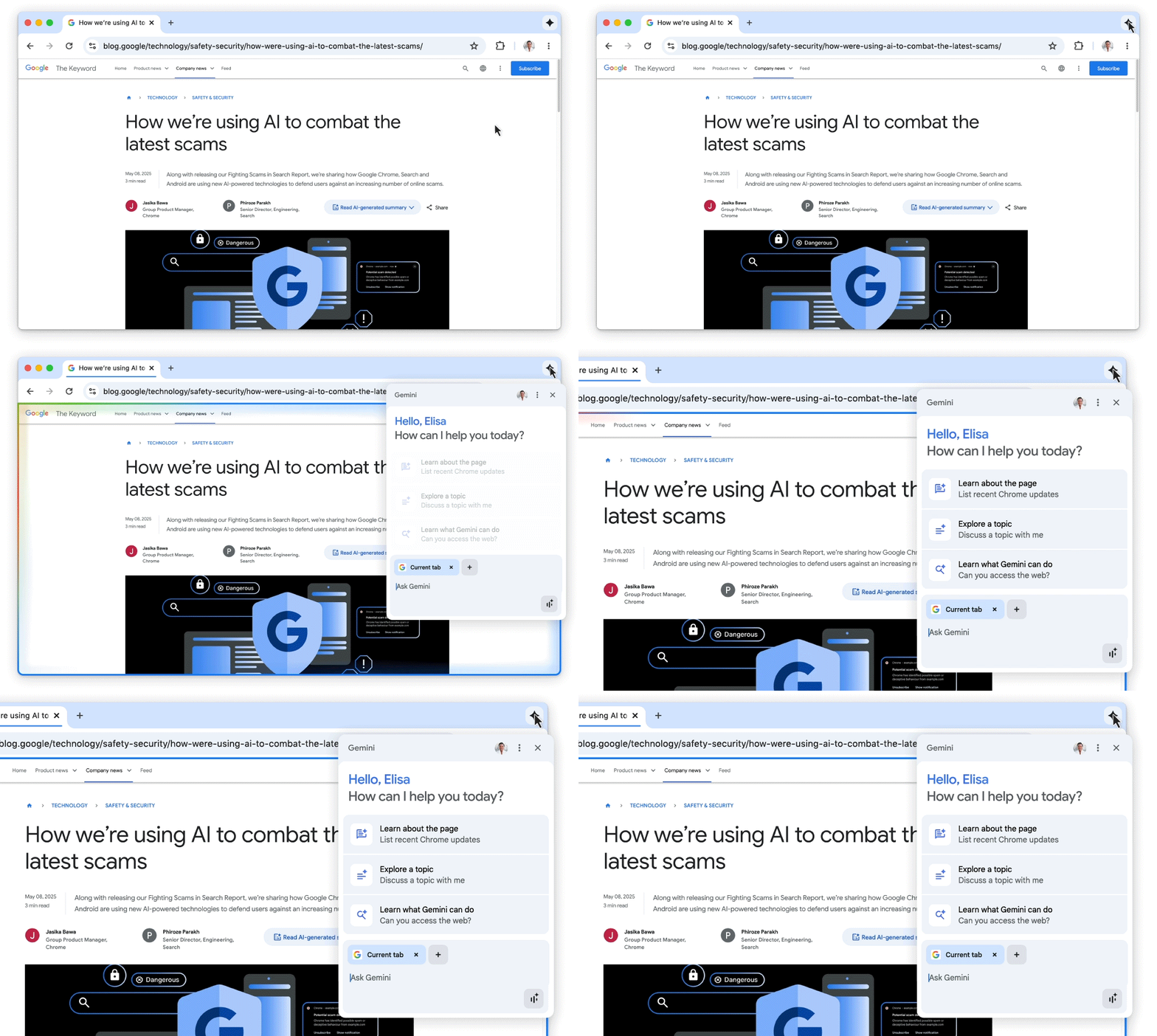
Now that it's looking like Chrome will remain in the Google fold, the browser is undergoing a Gemini-infused rebirth. Google claims the browser will see its most significant upgrade ever in the next few weeks as AI permeates every part of the experience. For people who use AI tools, some of these additions might actually be helpful, and for everyone else, well, Firefox still exists.
The most prominent change, and one that AI subscribers may have already seen, is the addition of a Gemini button on the desktop browser. This button opens a popup where you can ask questions about—and get summaries of—content in your open tabs. Android phones already have Gemini operating at the system level to accomplish similar tasks, but Google says the iOS Gemini app will soon be built into Chrome for Apple devices.
Northrop Grumman successfully resupplies ISS after overcoming software glitch
Running a day late, Northrop Grumman's Cygnus XL cargo freighter pulled alongside the International Space Station on Thursday, delivering more than 5 tons of supplies and experiments to the lab's seven-person crew.
NASA astronaut Jonny Kim took control of the space station's robotic arm to capture the Cygnus spacecraft at 7:24 am EDT (11:24 UTC) on Thursday. A short time later, the robot arm positioned the spacecraft over an attachment port on the station's Unity module, and 16 bolts drove closed to create a firm mechanical connection with the ISS.
The Cygnus XL supply ship will remain at the station for up to six months, during which time astronauts will unpack the spacecraft's cargo module and refill it with trash. The Cygnus spacecraft will depart the station and head for a destructive reentry over the remote Pacific Ocean to conclude the mission.
Software update shoves ads onto Samsung’s pricey fridges
Days after someone revealed the news on social media, Samsung confirmed today that it is showing advertisements on some US customers’ smart fridges. Samsung said the ads showing on some Family Hub-series fridges are part of a pilot program, but we suspect that they may become more permanent additions to Samsung fridges and/or other types of screen-equipped smart home appliances.
In a statement sent to Ars Technica, Samsung confirmed that it is “conducting a pilot program to offer promotions and curated advertisements on certain Samsung Family Hub refrigerator models in the US market.”
Samsung currently lists nine Family Hub refrigerators in the US, which have MSRPs ranging from $1,800 to $3,500. Family Hub fridges have 21.5- or 32-inch screens, which, until now, users have had autonomy over for displaying helpful or fun things, like photos and videos, memos, weather, timers, and a web browser. Some of those abilities require a Wi-Fi connection or a Samsung account.
FCC derided as “Federal Censorship Commission” after pushing Jimmy Kimmel off ABC
ABC pulled Jimmy Kimmel's show off the air yesterday, shortly after Federal Communications Commission Chairman Brendan Carr urged the Disney-owned company to take action against Kimmel or face consequences at the FCC over Kimmel's comments about Charlie Kirk's killer.
Carr appeared on right-wing commentator Benny Johnson's podcast yesterday and said, "We can do this the easy way or the hard way. These companies can find ways to change conduct, to take action, frankly on Kimmel, or there's going to be additional work for the FCC ahead." Carr urged Disney to suspend Kimmel and said broadcast stations that carry ABC content should refuse to carry Kimmel's show.
After Carr's comments and a statement by Nexstar that it would preempt Kimmel's show on its ABC-affiliated stations, ABC confirmed in a statement that "Jimmy Kimmel Live! will be preempted indefinitely." The decision was made by Disney CEO Robert Iger and TV division head Dana Walden, The New York Times reported. We contacted ABC today and will update this article if we get a response.
Nvidia, Intel to co-develop “multiple generations” of chips as part of $5 billion deal
In a major collaboration that would have been hard to imagine just a few years ago, Nvidia announced today that it was buying a total of $5 billion in Intel stock, giving Intel's competitor ownership of roughly 4 percent of the company. In addition to the investment, the two companies said that they would be co-developing "multiple generations of custom data center and PC products."
"The companies will focus on seamlessly connecting NVIDIA and Intel architectures using NVIDIA NVLink," reads Nvidia's press release, "integrating the strengths of NVIDIA’s AI and accelerated computing with Intel’s leading CPU technologies and x86 ecosystem to deliver cutting-edge solutions for customers."
Rather than combining the two companies' technologies, the data center chips will apparently be custom x86 chips that Intel builds to Nvidia's specifications. Nvidia will "integrate [the CPUs] into its AI infrastructure platforms and offer [them] to the market."
New attack on ChatGPT research agent pilfers secrets from Gmail inboxes
The face-palm-worthy prompt injections against AI assistants continue. Today’s installment hits OpenAI’s Deep Research agent. Researchers recently devised an attack that plucked confidential information out of a user’s Gmail inbox and sent it to an attacker-controlled web server, with no interaction required on the part of the victim and no sign of exfiltration.
Deep Research is a ChatGPT-integrated AI agent that OpenAI introduced earlier this year. As its name is meant to convey, Deep Research performs complex, multi-step research on the Internet by tapping into a large array of resources, including a user’s email inbox, documents, and other resources. It can also autonomously browse websites and click on links.
A user can prompt the agent to search through the past month’s emails, cross-reference them with information found on the web, and use them to compile a detailed report on a given topic. OpenAI says that it “accomplishes in tens of minutes what would take a human many hours.”
Trump’s Golden Dome will cost 10 to 100 times more than the Manhattan Project
One thing that's evident about President Donald Trump's proposal for the Golden Dome missile defense shield is that designing, deploying, and sustaining it will cost a lot of money, at least several hundred billion dollars, over the course of several decades.
Beyond that, it's really anyone's guess. That doesn't sit well with some lawmakers, but the Republican-controlled Congress committed $25 billion in July as a down payment for new missile-defense technologies.
The White House stated in May that Golden Dome will cost $175 billion over three years, but a new study from a center-right think tank concludes that it is simply not enough to develop the kind of multi-layer shield Trump described in a January executive order. It's also clear that it will take longer than three years to implement the full spectrum of defense capability envisioned for Golden Dome.
Some dogs can classify their toys by function
Certain dogs can not only memorize the names of objects like their favorite toys, but they can also extend those labels to entirely new objects with a similar function, regardless of whether or not they are similar in appearance, according to a new paper published in the journal Current Biology. It's a cognitively advanced ability known as "label extension," and for animals to acquire it usually involves years of intensive training in captivity. But the dogs in this new study developed the ability to classify their toys by function with no formal training, merely by playing naturally with their owners.
Co-author Claudia Fugazza of Eötvös Loránd University in Budapest, Hungary, likens this ability to a person calling a hammer and a rock by the same name, or a child understanding that "cup" can describe a mug, a glass, or a tumbler, because they serve the same function. “The rock and the hammer look physically different, but they can be used for the same function," she said. "So now it turns out that these dogs can do the same.”
Fugazza and her Hungarian colleagues have been studying canine behavior and cognition for several years. For instance, in 2023, we reported on the group's experiments on how dogs interpret gestures, such as pointing at a specific object. A dog will interpret the gesture as a directional cue, unlike a human toddler, who will more likely focus on the object itself. It's called spatial bias, and the team concluded that the phenomenon arises from a combination of how dogs see (visual acuity) and how they think, with "smarter" dog breeds prioritizing an object's appearance as much as its location. This suggests the smarter dogs' information processing is more similar to that of humans.
Meta’s $799 Ray-Ban Display is the company’s first big step from VR to AR
At last year's Meta Connect, Mark Zuckerberg focused less on the company's line of Quest VR headsets and more on the "Orion" prototype see-through augmented reality glasses, which he said could launch in some form or another "in the next few years." At the Meta Connect keynote Wednesday evening, though, Zuckerberg announced that the company's Meta Ray-Ban Display AR glasses would be available starting at $799 as soon as September 30.
To be sure, Meta's first commercial smartglasses with a built-in display are a far cry from the Orion prototype Zuckerberg showed off last year. The actual "display" part of the Ray-Ban Display is a paltry 600×600 resolution square that updates at just 30 Hz and takes up a tiny 20-degree portion of only the right eyepiece. Compared to the 70-degree field-of-view and head-tracked stereoscopic 3D "hologram" effect shown on the Orion lenses, that's a little disappointing.
Still, Zuckerberg was able to call the 42 pixels per degree (PPD) you get on the Ray-Ban Display's display "very high resolution," in a sense (the Meta Quest 3 tops out at around 25 PPD across its much larger display). And hands-on reports suggest the bright 5,000-nit display is viewable even in bright outdoor scenarios, thanks in part to Transitions lenses that automatically darken to block outside light.
How weak passwords and other failings led to catastrophic breach of Ascension
Last week, a prominent US senator called on the Federal Trade Commission to investigate Microsoft for cybersecurity negligence over the role it played last year in health giant Ascension's ransomware breach, which caused life-threatening disruptions at 140 hospitals and put the medical records of 5.6 million patients into the hands of the attackers. Lost in the focus on Microsoft was something as, or more, urgent: never-before-revealed details that now invite scrutiny of Ascension’s own security failings.
In a letter sent last week to FTC Chairman Andrew Ferguson, Sen. Ron Wyden (D-Ore.) said an investigation by his office determined that the hack began in February 2024 with the infection of a contractor's laptop after they downloaded malware from a link returned by Microsoft’s Bing search engine. The attackers then pivoted from the contractor device to Ascension’s most valuable network asset: the Windows Active Directory, a tool administrators use to create and delete user accounts and manage system privileges to them. Obtaining control of the Active Directory is tantamount to obtaining a master key that will open any door in a restricted building.
Wyden blasted Microsoft for its continued support of its three-decades-old implementation of the Kerberos authentication protocol that uses an insecure cipher and, as the senator noted, exposes customers to precisely the type of breach Ascension suffered. Although modern versions of Active Directory by default will use a more secure authentication mechanism, it will by default fall back to the weaker one in the event a device on the network—including one that has been infected with malware—sends an authentication request that uses it. That enabled the attackers to perform Kerberoasting, a form of attack that Wyden said the attackers used to pivot from the contractor laptop directly to the crown jewel of Ascension’s network security.
Right-wing political violence is more frequent, deadly than left-wing violence
After the Sept. 10, 2025, assassination of conservative political activist Charlie Kirk, President Donald Trump claimed that radical leftist groups foment political violence in the US, and “they should be put in jail.”
“The radical left causes tremendous violence,” he said, asserting that “they seem to do it in a bigger way” than groups on the right.
Top presidential adviser Stephen Miller also weighed in after Kirk’s killing, saying that left-wing political organizations constitute “a vast domestic terror movement.”
No Nissan Ariya for model-year 2026 as automaker cancels imports
Last week we drove the new Nissan Leaf, an inexpensive compact electric vehicle. Now equipped with things like active battery thermal management, the new Leaf is actually Nissan's second modern EV, after the debut a couple of years ago of the Ariya SUV. But if you want an Ariya, you ought to hurry—the model has been cut from Nissan USA's offerings for model-year 2026, according to a report in Automotive News.
According to a letter sent by Nissan to its dealers, obtained by the trade publication, "This decision enables the company to reallocate resources and optimize its EV portfolio as the automotive landscape continues to evolve." Whether the Ariya returns for MY27 is unclear and probably depends both on the state of the US EV market by then as well as Nissan's own finances.
The blame? The 15 percent import tariff levied by President Trump, which is one straw too many for the financially beleaguered automaker, as the Ariya is built in Japan at Nissan's Tochigi plant and must be shipped across the ocean to fulfill US orders.
You can hold on to your butts thanks to DNA that evolved in fish
Evolution has adapted the digits of mammals for an enormous range of uses, from our opposable thumbs to the spindly digits that support bat wings to the robust bones that support the hoofs of horses. But how we got digits in the first place hasn't been entirely clear. The fish that limbed vertebrates evolved from don't have obvious digit equivalents, and the most common types of fish just have a large collection of rays supporting their fins.
Despite this uncertainty, we have identified some genes that seem to be essential for both digit formation and the development of rays in the fins of fish, suggesting that there are parallels between the two. But a new study suggests that these parallels are a bit of an accident, and digits come by re-deploying a genetic network that controls a completely different process: the formation of the cloaca, a single organ that handles all of the fish's excretion.
Hox genes and digitsOne of the key regulators of limb development is a set of genes called homeobox proteins, which attach to DNA and regulate the activity of nearby genes. In animals, many of these homeobox, or hox genes, are formed into clusters. Mammals have four clusters of hox genes, each of which encodes roughly 10 individual homeobox proteins. The cluster helps to organize where the hox genes are active, with the genes at one end of the cluster being active at the front of an embryo, and those at the other end active at the tail.
White House officials reportedly frustrated by Anthropic’s law enforcement AI limits
Anthropic's AI models could potentially help spies analyze classified documents, but the company draws the line at domestic surveillance. That restriction is reportedly making the Trump administration angry.
On Tuesday, Semafor reported that Anthropic faces growing hostility from the Trump administration over the AI company's restrictions on law enforcement uses of its Claude models. Two senior White House officials told the outlet that federal contractors working with agencies like the FBI and Secret Service have run into roadblocks when attempting to use Claude for surveillance tasks.
The friction stems from Anthropic's usage policies that prohibit domestic surveillance applications. The officials, who spoke to Semafor anonymously, said they worry that Anthropic enforces its policies selectively based on politics and uses vague terminology that allows for a broad interpretation of its rules.
HBO Max is “way underpriced,” Warner Bros. Discovery CEO says
Someone might want to tell David Zaslav to read the room. Despite people’s ongoing frustration with the rising prices of streaming services—and just about everything else—the CEO of Warner Bros. Discovery (WBD) thinks that there is reason for HBO Max to charge more.
Zaslav shared his sentiments while speaking at the Goldman Sachs Cornucopia + Technology conference today in San Francisco. The Hollywood Reporter quoted Zaslav as saying:
The fact that this is quality—and that’s true across our company, motion picture, TV production [and] streaming quality—we all ... think that gives us a chance to raise price. We think we’re way underpriced.
Today, HBO Max starts at $10 per month with ads, $17/month for no ads, and $21/month for no ads and premium features (4K streaming, Dolby Atmos, and the ability to stream from more devices simultaneously and perform more downloads). The streaming platform has raised prices twice since launching (as Max) in May 2023. In June 2024, the Standard, ad-free plan went from $16/month to $17/month, and annual subscription fees went up by $20 or $10, depending on the plan. Subscription fees also increased in January 2023.
Ousted CDC director to testify before Senate after RFK Jr. called her a liar
Susan Monarez, the former director of the Centers for Disease Control and Prevention who was ousted last month after mere weeks in the role, is set to testify before the Senate next week about what was behind her dramatic downfall, as well as the ongoing chaos at the public health agency under health secretary and anti-vaccine activist Robert F. Kennedy Jr.
In a hearing last Thursday before the Senate Finance Committee, a combative Kennedy repeatedly called Monarez a liar and made the incredible claim that he fired her after he asked her directly if she was a trustworthy person and she responded "no." While Senators clearly struggled to believe that explanation, Sen. Thom Tillis (R-N.C.) wryly noted that Kennedy should have asked her the question before having the Senate confirm her for the role.
In an op-ed published in The Wall Street Journal the same day as Kennedy's testimony, Monarez gave a different account of her firing—one corroborated by independent reporting—saying that she was ousted after she refused Kennedy's directives to fire senior CDC staff and pre-approve vaccine recommendations from an advisory committee he has stacked with fellow anti-vaccine advocates.
Senator blasts Microsoft for making default Windows vulnerable to “Kerberoasting”
A prominent US senator has called on the Federal Trade Commission to investigate Microsoft for “gross cybersecurity negligence,” citing the company’s continued use of an obsolete and vulnerable form of encryption that Windows uses by default.
In a letter to FTC Chairman Andrew Ferguson, Sen. Ron Wyden (D–Ore.) said an investigation his office conducted into the 2024 ransomware breach of the health care giant Ascension found that the default use of the RC4 encryption cipher was a direct cause. The breach led to the theft of medical records of 5.6 million patients.
It's the second time in as many years that Wyden has used the word “negligence” to describe Microsoft's security practices.